Residential & commercial
Ceiling Fan Installation
A ceiling fan has to be supported and wired differently from a light fixture. We install new fans, swap fixtures for fans, add wall controls and fix fans that wobble, hum or won't run.
What does ceiling fan installation involve?
Ceiling fan installation means mounting a fan on an electrical box rated to carry its weight and motion, connecting it to a circuit, and wiring a control for the fan and its light. When a room has no ceiling fixture, it also means running a new cable and adding a wall switch.
North Carolina summers are long and humid, so ceiling fans earn their keep in the Triangle. They also help in winter. Reversed to spin clockwise on low, a fan pushes warm air down from the ceiling, which helps in rooms with vaulted or two-story ceilings.
Common ceiling fan jobs
- Replacing a light fixture with a fan, including swapping the old box for a fan-rated box or brace
- Adding a fan where there's no fixture, with new wiring and a wall control
- Separate fan and light control, using a second switched conductor or a wireless control
- High and vaulted ceilings, with the right downrod length and a sloped-ceiling adapter
- Outdoor fans for porches, patios and pergolas, using damp- or wet-rated fans
- Repairs for fans that wobble, hum, won't change speed or have stopped running
Why does the electrical box matter for a ceiling fan?
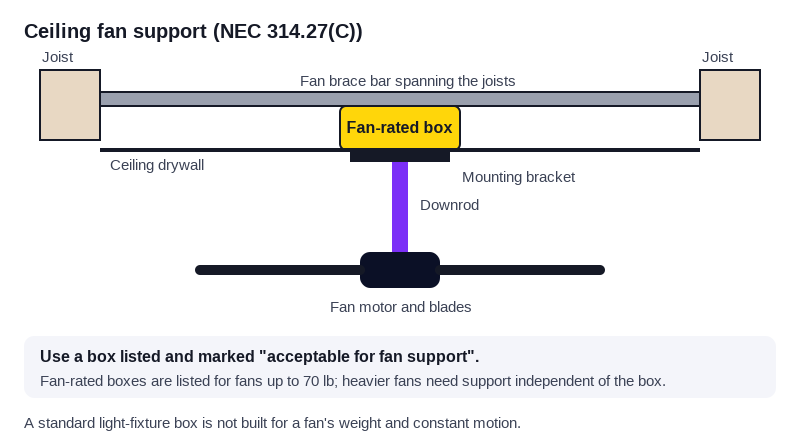
A standard light-fixture box is designed to hold a light fixture, not a fan. A ceiling fan is heavier, and its motion puts constant stress on the mounting. A fan hung on the wrong box can loosen over time, wobble and, in the worst case, fall. The NEC (314.27(C)), as adopted in the North Carolina State Building Codes, requires fans to hang from a box or brace listed for fan support, attached to framing.
Choosing the right downrod
| Ceiling height | Typical downrod |
|---|---|
| 8 ft | Flush or close-mount (hugger) |
| 9 ft | About 6 in |
| 10 ft | About 12 in |
| 12 ft | About 24 in |
| 14 ft and up | About 36 in or longer |
The aim is blades roughly 8 to 9 feet above the floor. Always follow the fan maker's minimum clearance from the floor.
What size fan does a room need?
| Room size | Typical blade span |
|---|---|
| Up to 75 sq ft (small bath, laundry) | 29 to 36 in |
| 76 to 144 sq ft (bedroom, office) | 36 to 42 in |
| 145 to 225 sq ft (large bedroom, kitchen) | 44 to 50 in |
| 226 to 400 sq ft (family room, bonus room) | 50 to 54 in or larger |
Very large or open-plan rooms often work better with two fans than one oversized fan. The U.S. Department of Energy notes that a ceiling fan lets you raise the thermostat setting by about 4°F with no reduction in comfort. That's because fans cool people, not rooms, so turn them off in empty rooms.
How do you fix a wobbly or humming fan?
Wobble usually means loose mounting screws, a blade that's bent or out of balance, or a box that isn't fan-rated. Humming often comes from a standard light dimmer used as a speed control. Fan motors need a fan-rated control. A fan that runs slowly or not at all may need a new capacitor, receiver or switch.
Fans for businesses
Restaurants, shops, offices and covered outdoor seating areas use ceiling fans for comfort and air movement. Commercial fans are often larger and heavier, and they need sturdy structural mounting and appropriate controls.
Ceiling fans by location
Bonus rooms and screened porches are typical fan projects in Apex and Clayton. In older Raleigh and Durham homes, ceilings often had no box at all, so fans need new wiring.
Related services: lighting installation, switches and dimmers and new circuits.
Common questions about ceiling fans
Can I hang a ceiling fan where a light fixture is now?
Often, yes, but the electrical box has to be rated for fan support. Many light-fixture boxes aren't, and a fan's weight and motion can loosen them. Swapping in a fan-rated box or brace is usually part of the job.
Can a fan go in a room with no existing fixture?
Yes. That involves running a new cable from a power source to the ceiling, installing a fan-rated box, and adding a wall switch or control.
Why does my ceiling fan wobble or hum?
Wobble usually comes from loose mounting, unbalanced blades or a box that isn't fan-rated. Humming often comes from a standard dimmer used as a fan speed control. Fan motors need a fan-rated control, not a light dimmer.
Call about a ceiling fan
All four locations are open 24 hours, 7 days a week.