Residential & commercial
Outlets and Switches
Outlets and switches are the parts of your electrical system you touch every day. We replace worn devices, add protection where code calls for it, and fix outlets that stop working.
What does outlet and switch work cover?
Outlet and switch work means installing, replacing and repairing the receptacles and wall controls throughout a home or business. That includes adding GFCI and AFCI protection, converting ungrounded two-prong outlets, adding outlets where you need them, and installing dimmers, smart switches and USB outlets.
Outlets and switches wear out. Contacts loosen so plugs fall out, and connections behind the cover plate can work loose and heat up. Older homes often have too few outlets, which leads to extension cords and overloaded power strips.
Which type of outlet do you need?
| Type | What it does | Where it's used |
|---|---|---|
| GFCI | Shuts off power when current leaks to ground, protecting people from shock | Bathrooms, kitchens, garages, laundry, outdoors, crawl spaces, basements |
| AFCI | Detects dangerous arcing that can start fires | Bedrooms and most living-area circuits in newer homes |
| Tamper-resistant | Shutters block objects pushed into one slot | Required in new residential work; good with small children |
| Weather-resistant with in-use cover | Resists moisture and corrosion; cover stays closed with a cord plugged in | Porches, patios, decks, exterior walls |
| 20-amp | Higher-capacity receptacle on a 20-amp circuit | Kitchen counters, garages, workshops, commercial spaces |
| USB / USB-C | Built-in charging ports | Kitchens, bedrooms, offices |
When does an outlet or switch need replacing?
- Plugs fall out or feel loose
- The outlet or cover plate is warm, cracked, or has brown or black marks
- A switch crackles, sparks or feels hot, or a dimmer buzzes
- Outlets are dead and resetting the GFCI doesn't bring them back
- Two-prong outlets with no way to plug in grounded equipment
- Outlets missing from places code expects them, such as kitchen counters and bathrooms
A warm or scorched outlet is a fire warning. Stop using it, switch off its breaker if you can do so safely, and call. Every Next Door Electricians location is open 24 hours.
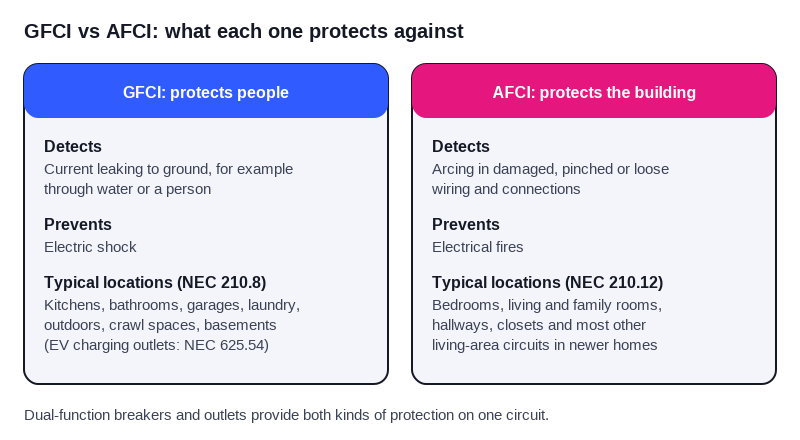
GFCI locations come from NEC 210.8, and AFCI requirements come from NEC 210.12, as adopted in the North Carolina State Building Codes. NFPA offers free read-only access to the NEC (NFPA 70). Older homes were built under earlier rules and aren't required to be updated everywhere at once, but adding protection is often the most useful safety upgrade.
How should two-prong outlets be grounded?
Swapping a two-prong outlet for a three-prong one without a ground wire is a common shortcut, and it's unsafe. The outlet looks grounded but isn't. The NEC (406.4(D)) allows only specific fixes: run a new grounded circuit, add a ground conductor where permitted, or protect the outlet with GFCI and label it "No equipment ground." Which fix fits depends on the wiring behind the wall, which is why older homes often pair this work with rewiring.
Switches, dimmers and smart controls
Switch work includes three-way and four-way switching for halls and stairs, LED-compatible dimmers, occupancy and vacancy sensors, timers for exhaust fans, and smart switches. Many smart switches need a neutral wire in the switch box, and some older boxes don't have one. That's worth checking before buying a set of switches.
Commercial outlets and switches
In offices, shops and restaurants, outlet work often means adding dedicated circuits for equipment, installing floor boxes, and adding GFCI protection in kitchens and wet areas.
Outlet work by location
Two-prong outlets are common in older homes in Raleigh and Durham, including Durham rental turnovers. Newer homes in Apex and Clayton often call for smart and USB upgrades and outdoor GFCI outlets.
Related services: lighting, troubleshooting and repairs and panel upgrades.
Common questions about outlets and switches
What is a GFCI outlet and where is it required?
A GFCI (ground-fault circuit interrupter) outlet cuts power in a fraction of a second when it senses current leaking to ground, which protects people from shock. The electrical code requires GFCI protection in places such as bathrooms, kitchens, garages, laundry areas, outdoors, crawl spaces and basements.
What is the difference between GFCI and AFCI protection?
GFCI protection guards people against shock from ground faults. AFCI (arc-fault circuit interrupter) protection detects dangerous arcing in wiring that can start fires, and is required on many living-area circuits in newer homes. Dual-function breakers and outlets provide both.
Can I just swap a two-prong outlet for a three-prong one?
Not unless the box is actually grounded. Installing a three-prong outlet with no ground wire gives a false sense of safety. The fixes are to run a ground, install a new grounded circuit, or install GFCI protection and label the outlet 'No equipment ground', as the code allows.
Why does an outlet feel warm or look scorched?
Heat or discoloration usually means a loose connection, a worn outlet or an overloaded circuit. Stop using it and have it checked. Loose connections can arc and start fires.
Call about outlets and switches
All four locations are open 24 hours, 7 days a week.