Residential & commercial
EV Charger Installation
A Level 2 charger can refill most electric vehicles overnight. Installing one safely starts with a load check on your panel and a dedicated 240-volt circuit sized for the charger.
What is involved in installing an EV charger?
EV charger installation means adding a Level 2 charging station, or a 240-volt outlet for a plug-in charger, on its own dedicated circuit. It starts with a load calculation to confirm the electrical panel and service can carry the extra demand. Then the right-size circuit is run to the charger's location.
Electric vehicles are a common sight on Triangle commutes along I-40, I-540 and US 1. Most owners charge at home overnight, so a properly installed Level 2 charger is usually the most useful upgrade after buying an EV.
Level 1 vs Level 2 charging
| Feature | Level 1 | Level 2 |
|---|---|---|
| Voltage | 120 volts (standard outlet) | 240 volts (dedicated circuit) |
| Charging speed | Slow, often a few miles of range per hour | Several times faster; most daily driving refilled overnight |
| Electrical work | Usually none, if a suitable outlet exists | New 240-volt circuit, sized to the charger |
| Best for | Plug-in hybrids, short commutes | Battery EVs, longer commutes, two-EV households |
Sizing the circuit
An EV charger is a continuous load, so the National Electrical Code (NEC 625.41), as adopted in the North Carolina State Building Codes, requires the circuit to be rated at 125% of the charger's output:
| Charger output | Minimum circuit breaker |
|---|---|
| 16 amps | 20 amps |
| 24 amps | 30 amps |
| 32 amps | 40 amps |
| 40 amps | 50 amps |
| 48 amps | 60 amps |
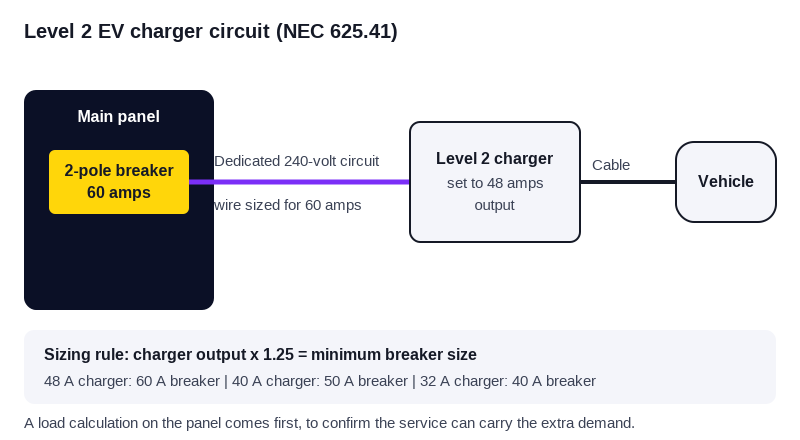
Most hardwired chargers can be set to a lower output to fit the circuit you have. A bigger charger isn't always better if your car can't accept that rate.
Hardwired charger or NEMA 14-50 outlet?
- Hardwired chargers support higher amperage, have no plug to wear out, and suit outdoor driveway mounts.
- NEMA 14-50 outlets let you use a portable or plug-in charger and take it with you. Use a heavy-duty, EV-rated receptacle. The NEC (625.54) calls for GFCI protection on EV charging outlets.
What if my panel is full?
A full or undersized panel doesn't automatically mean a service upgrade. Options include:
- A load calculation that may show more spare capacity than expected
- A lower charger setting that still refills a daily commute overnight
- A load-management device, or a charger with built-in power sharing for two cars
- A panel or service upgrade when the home is moving toward all-electric
Steps in a typical home installation
- Choose the charger location, usually a garage wall or near the driveway, within cable reach of the car's charge port.
- Run a load calculation on the panel.
- Pull the permit for the new circuit.
- Run the circuit, mount the charger or outlet, and set the charger's output to match the breaker.
- Pass inspection, then test charging with your vehicle.
Workplace and commercial EV charging
Businesses add chargers for employees, fleets and customers. Commercial charging adds questions about the number of ports, power sharing between them, and where to mount equipment in a parking lot. Start with a load study of the building's service.
EV chargers by location
Two-car garages in newer Apex neighborhoods often end up with two chargers. Long commutes from Clayton make Level 2 charging especially useful. Older homes in Raleigh and Durham sometimes need panel capacity added first.
Related services: panel upgrades, new circuits and outlets and switches.
Common questions about EV chargers
What is the difference between Level 1 and Level 2 charging?
Level 1 charging uses a standard 120-volt household outlet and adds range slowly, often only a few miles per hour. Level 2 charging uses a 240-volt circuit and is several times faster, enough to refill most daily driving overnight.
What size circuit does a Level 2 charger need?
Chargers are continuous loads, so the circuit must be rated at 125% of the charger's output. A 32-amp charger needs a 40-amp circuit, a 40-amp charger needs a 50-amp circuit, and a 48-amp charger needs a 60-amp circuit.
Should I get a hardwired charger or a NEMA 14-50 outlet?
Both work. A hardwired charger allows higher amperage and has no plug to wear out. A NEMA 14-50 outlet lets you use a plug-in charger you can take with you. Outlet-connected chargers need GFCI protection, and the outlet should be a heavy-duty, EV-rated type.
Do I need a permit to install an EV charger?
A new 240-volt circuit for an EV charger generally requires an electrical permit and inspection through your local inspections department.
Call about an EV charger
All four locations are open 24 hours, 7 days a week.