Residential & commercial
Generator Installation
When storms or ice knock out power, a generator only helps if it's connected safely. We install standby generators and the transfer equipment that keeps portable units off the grid.
What does generator installation include?
Generator installation is the electrical work that lets a generator power your home or business safely during an outage. For a standby generator, that means connecting it through an automatic transfer switch. For a portable generator, it means an exterior inlet plus a manual transfer switch or a panel interlock, so the generator can never feed power back onto utility lines.
Central North Carolina gets outages from summer thunderstorms, the remnants of tropical systems, and winter ice storms that bring down trees and lines. Hurricane Fran in 1996 and the December 2002 ice storm both left many Triangle homes without power for days. For homes with a well pump, sump pump, medical equipment or a home office, a safe generator connection matters.
Should you choose a standby or portable generator?
| Feature | Standby generator | Portable generator |
|---|---|---|
| Fuel | Natural gas or propane | Usually gasoline; some propane or dual-fuel |
| Starting | Starts by itself when power fails | Started and connected by hand |
| Connection | Automatic transfer switch | Inlet box with manual transfer switch or interlock kit |
| Coverage | Selected circuits or the whole home | A handful of essential circuits |
| Placement | Permanent pad, with clearances from windows and doors | Run outdoors only, well away from openings |
Can you plug a generator into a wall outlet?
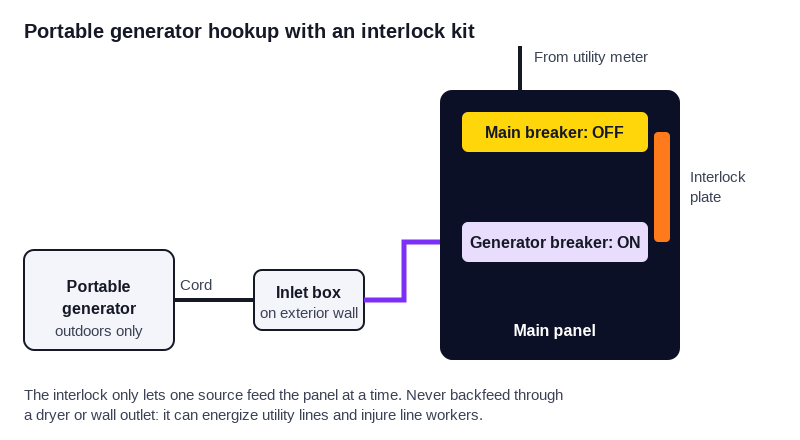
No. Plugging a generator into a dryer or wall outlet with a double-male cord ("backfeeding") can energize the utility lines outside your home and seriously injure line workers. It can also start a fire in your wiring. Always connect through a transfer switch or interlock.
Transfer switches and interlock kits
- Automatic transfer switch (ATS): senses an outage, starts the standby generator and switches your circuits over, then switches back when utility power returns.
- Manual transfer switch: a small subpanel of selected circuits you switch to generator power by hand.
- Interlock kit: a mechanical plate on the main panel that prevents the main breaker and the generator breaker from being on at the same time. Paired with an exterior inlet box, it's often the simplest safe setup for a portable generator.
Sizing: what do you need to run?
Start with a list of must-run items. A typical "essentials" list includes the refrigerator and freezer, well pump, sump pump, furnace blower or gas furnace controls, some lights, internet equipment and phone chargers. Whole-home coverage adds air conditioning, electric water heaters and ranges, which takes a much larger generator. Motor loads such as well pumps and AC compressors draw extra current when they start, so they need to be part of the sizing.
Steps in a standby installation
- Load assessment and choice of whole-home or essential-circuit coverage.
- Site selection that meets the manufacturer's clearances and any HOA rules.
- Permits for the electrical work. A gas line or propane tank also needs a gas permit, handled by a qualified gas installer.
- Set the generator, install the transfer switch, wire the controls.
- Inspection, start-up and a test transfer.
Generators for businesses
Restaurants with refrigeration, offices with servers and shops with security systems use generators to ride through outages. Commercial installs size the generator to the critical loads and transfer them automatically.
Generators by location
Rural properties around Clayton often depend on well pumps. Raleigh homeowners remember multi-day outages after major storms. Parts of north Durham are rural. In newer Apex neighborhoods, HOA rules on equipment placement often apply.
Related services: panel upgrades, storm damage repair and wiring.
Common questions about generators
Can I plug my portable generator into a dryer outlet?
No. Backfeeding through an outlet with a double-ended cord can energize the utility lines outside your home and endanger line workers, and it can damage your wiring. Use a transfer switch or an interlock kit with a proper inlet.
What is the difference between a standby generator and a portable generator?
A standby generator is permanently installed, runs on natural gas or propane, and starts on its own through an automatic transfer switch when the power goes out. A portable generator runs on gasoline or propane, is started by hand, and connects through a manual transfer switch or interlock.
What is an interlock kit?
An interlock kit is a mechanical plate on your main panel that makes it impossible to turn on the main breaker and the generator breaker at the same time. Paired with an exterior inlet, it lets a portable generator power selected circuits safely.
How big a generator do I need?
It depends on what you want to run: a few essential circuits such as the refrigerator, well pump, sump pump, furnace fan and some lights, or the whole home including air conditioning. Start with a list of must-run items.
Call about a generator
All four locations are open 24 hours, 7 days a week.