Residential & commercial
Wiring and Rewiring
Wiring is the part of an electrical system you never see until it fails. We add new circuits, replace worn or outdated wiring, and rewire whole homes and commercial spaces.
What does wiring and rewiring cover?
Wiring and rewiring covers everything from adding a single new circuit to replacing all the wiring in a building. It includes running power to new rooms and equipment, replacing outdated or damaged cable, and bringing older systems up to modern safety standards.
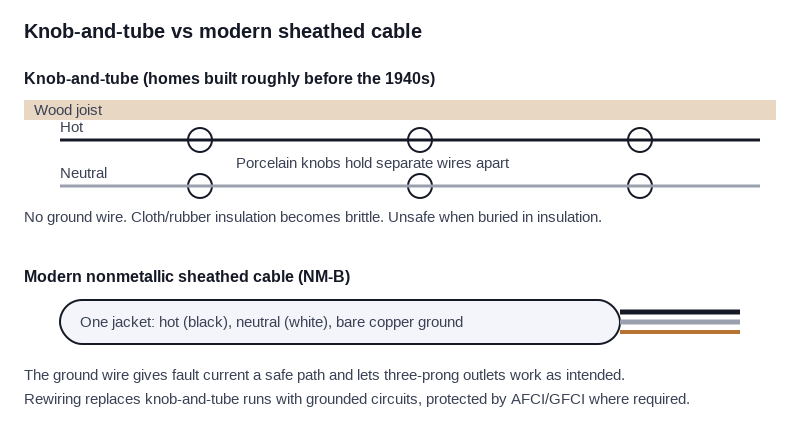
The Triangle has housing from every era, and each era has its own wiring. Pre-war houses in Raleigh's and Durham's older neighborhoods may still have knob-and-tube wiring. Some 1960s and 1970s homes have aluminum branch circuits. Newer homes mostly need added circuits for workshops, offices and outdoor kitchens.
Which types of wiring need replacing?
| Wiring type | Where you find it | Main concerns |
|---|---|---|
| Knob-and-tube | Homes built roughly before the 1940s | No ground; brittle insulation; unsafe when buried in insulation; often spliced into by later work |
| Cloth-sheathed cable | Mid-century homes | Insulation can crumble at fixtures and in hot attics; often ungrounded |
| Aluminum branch wiring | Some homes built in the mid-1960s to mid-1970s | Connections can loosen and overheat at devices not rated for aluminum |
| Damaged or amateur wiring | Any age | Rodent damage, open splices, undersized wire, missing boxes |
How can you tell your wiring needs work?
- Two-prong outlets throughout the house, or three-prong outlets with no ground behind them
- Lights that dim when appliances start, or breakers that trip on normal use
- Warm switch plates, a burning smell, or discolored outlets
- Visible knob-and-tube in the attic or crawl space, or crumbling cable insulation
- An inspection report, insurer or buyer asking for wiring to be updated
- A renovation that opens walls, which is the easiest time to rewire
Should you rewire the whole home or only part of it?
A whole-home rewire replaces every branch circuit, usually along with the panel. It makes sense when most of the house is on outdated wiring.
A partial rewire targets the worst areas first, such as kitchens, bathrooms or any remaining knob-and-tube. It spreads the cost over time.
In both cases, new cable is fished through walls and ceilings from the attic and crawl space where possible. That keeps drywall and plaster openings small, and the house usually stays livable throughout.
New circuits and dedicated lines
Many wiring calls aren't about old wiring at all. They're for new circuits: a dedicated line for a microwave, freezer or window AC unit, 240-volt power for a workshop tool or hot tub, circuits for a finished basement or bonus room, or feeders to a detached garage or shop. In commercial spaces, new circuits often serve kitchen equipment, servers, signage and tenant fit-outs.
What rewiring involves
- Survey the panel, attic, crawl space and circuits to map what's there.
- Plan circuits to current code, including GFCI and AFCI protection where required.
- Pull a permit and schedule rough-in inspection where required.
- Run new cable, install new boxes and devices, and remove or abandon the old wiring safely.
- Pass final inspection, then label the panel.
Wiring work across the Triangle
For Raleigh's historic neighborhoods, see our Raleigh electrician page. For Durham's mill houses and bungalows, see electrician in Durham. Shop and outbuilding feeders are common in Clayton, and new-circuit work is common in Apex.
Related services: panel upgrades, outlets and switches and electrical troubleshooting.
Common questions about wiring and rewiring
How do I know if my house has knob-and-tube wiring?
Knob-and-tube wiring uses separate single wires run through porcelain knobs and tubes, usually visible in attics, basements or crawl spaces. It is found mostly in homes built before the 1940s. It has no ground wire, and many insurers and buyers ask for it to be replaced.
Is aluminum wiring dangerous?
Aluminum branch-circuit wiring was used in some homes built in the mid-1960s to mid-1970s. Its connections can loosen and overheat over time, especially at outlets and switches not rated for aluminum. It can be made safer with approved connectors or replaced with copper circuits.
Do I have to move out for a whole-house rewire?
Usually not. Rewiring is typically done room by room so most of the house stays powered each day. Some drywall access holes are normally needed, and patching is planned as part of the job.
Why do I need a dedicated circuit?
Large or continuous loads, such as microwaves, refrigerators, space heaters, EV chargers, window AC units and some commercial equipment, can overload a shared circuit and trip the breaker. A dedicated circuit gives that equipment its own breaker and wire sized for the load.
Call about wiring or rewiring
All four locations are open 24 hours, 7 days a week.