Residential & commercial
Lighting Installation and Repair
Good lighting makes a room usable and a property safer after dark. We install, replace and repair interior, exterior and commercial lighting, and track down the cause of flicker.
What lighting work do electricians handle?
Lighting installation and repair covers new fixtures, new lighting circuits and switching, outdoor and security lighting, and fixing lights that flicker, buzz or don't work. An electrician is the right call whenever lighting needs new wiring, new boxes, new switches or a diagnosis of a fault.
Most homes in the Triangle were built with a basic set of fixtures: a ceiling light per bedroom, a few cans in the kitchen, and a porch light. Better lighting is one of the most noticeable upgrades a home or business can make.
What indoor lighting can an electrician install?
- Recessed lighting. Slim LED wafer lights need no bulky housing, so they fit in shallow ceilings, including first-floor ceilings with a floor directly above. Use IC-rated, airtight fixtures where the ceiling has insulation.
- Under-cabinet lighting. Hardwired LED strips or puck lights for kitchen counters, on a switch or dimmer.
- Pendants and chandeliers. Heavy fixtures need a box and support rated for their weight.
- Bathroom lighting. Vanity lights and damp-rated fixtures. Fixtures over a tub or shower need the right wet or damp rating.
- Switching and dimming. Three-way switches for stairs and halls, LED-compatible dimmers, occupancy sensors and smart switches.
What are the options for outdoor and security lighting?
Outdoor lighting makes a property safer and easier to use after dark. Common projects include motion-sensor floodlights over driveways, dusk-to-dawn lights on garages and outbuildings, deck, patio and pergola lighting, and pathway lighting. Outdoor fixtures need wet-location ratings, weatherproof boxes and GFCI protection where receptacles are involved. In storm-prone weather, fixtures need to be mounted solidly.
Why do lights flicker, and when should you worry?
| Symptom | Likely cause |
|---|---|
| One LED bulb flickers on a dimmer | Dimmer not rated for LED, or bulb not dimmable |
| One fixture flickers, others fine | Loose bulb, failing driver or loose connection at the fixture |
| Lights dim when the AC or a large appliance starts | Heavy load on a shared circuit or a service connection problem |
| Many lights flicker across the house | Loose neutral or service issue. Treat as urgent. |
Whole-house flicker, flicker with buzzing, or switches that feel warm can point to a loose connection that may overheat. Those calls go to electrical troubleshooting and repair, and every location is open 24 hours.
Switching to LED
LED lighting is the default for new work. According to the U.S. Department of Energy, residential LEDs, especially ENERGY STAR rated products, use at least 75% less energy than incandescent lighting and can last up to 25 times longer. Swapping bulbs is a homeowner job. An electrician comes in when old fixtures, dimmers or wiring don't work well with LEDs, or when you want to replace bulky can lights with slim LED fixtures.
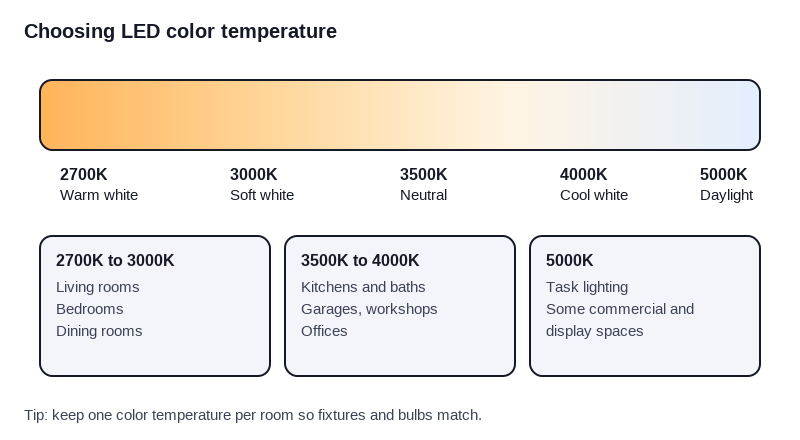
Color temperature matters as much as brightness. Warmer light (around 2700K to 3000K) suits living rooms and bedrooms. Cooler light (3500K to 4000K) is common in kitchens, garages, workshops and commercial spaces. Keeping one color temperature per room avoids a patchwork look.
Commercial lighting
For offices, shops and restaurants, lighting work includes replacing fluorescent troffers with LED panels, converting fixtures to LED, adding exterior building and parking lighting, display lighting, and exit and emergency lighting. Commercial projects can be scheduled outside business hours.
What a lighting project involves
- Walk through the space, check the existing circuits and decide where fixtures and switches go.
- Choose fixtures with the right ratings: IC, damp or wet location, dimmable, and weight.
- Run new cable and boxes, cut in fixtures and set switches or dimmers.
- Test dimming range, switching and GFCI protection, then clean up.
Lighting by location
Lighting projects look different in each town. Apex homeowners often replace builder-grade fixtures (Apex electrician). Rural Clayton properties need driveway and outbuilding lighting (Clayton electrician). Renovated older homes in Raleigh and Durham often get new kitchen and living-room lighting.
Related services: ceiling fan installation, outlets and switches and new circuits and rewiring.
Common questions about lighting
Why do my LED lights flicker?
LED flicker usually comes from a dimmer that isn't rated for LED bulbs, a loose connection, a failing fixture driver, or voltage changes when a large appliance starts. If many lights flicker at once, or the flicker comes with buzzing or warm switches, have the circuit checked.
Can recessed lights go in a ceiling that has insulation?
Yes, if the fixtures are rated IC (insulation contact). Most new LED wafer and canless fixtures are IC-rated and airtight, so they can sit against insulation without a fire risk.
What outdoor lighting options are there?
Common choices are motion-sensor security floodlights, dusk-to-dawn porch and garage lights, pathway and landscape lighting, and lighting for decks, patios and detached garages. Outdoor fixtures need wet-location ratings and proper weatherproof boxes.
Call about lighting
All four locations are open 24 hours, 7 days a week.